# Schedules

If you only want to run a one-time backup, you can click on \[**Backup**] to start your backup.

If you'd like to schedule a reoccurring backup, for example, once daily, instead continue by clicking \[**Schedule**] and define the following:

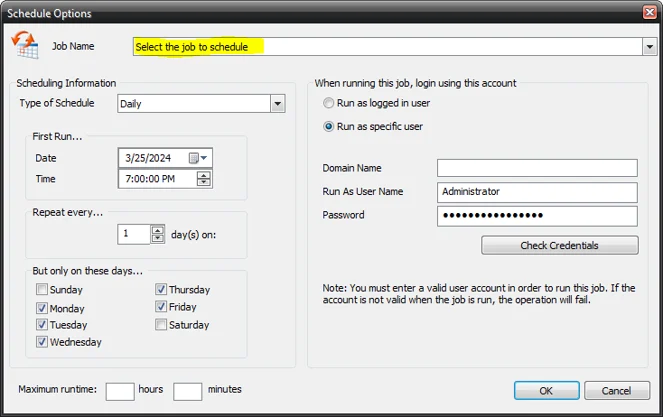
1. Your current backup job is selected under Job Name. If it's not selected, pick the job you want to schedule from the drop-down menu (see yellow highlighting below).
2. Under "**Scheduling Information**", specify when and at what intervals the backup job should run.&#x20;
3. Enter the user who has access to the selected data to ensure that the backup works without errors even if you're logged out. Then click \[**Check Credentials**].
4. Click \[**OK**] to confirm. You will find the backup job under "**Schedule**" at the top of the main navigation. The backup job can be adjusted at any time.<br>

   <figure><img src="/files/sOFSbD0cXBPYjIVTEOHQ" alt=""><figcaption><p>The Schedule Options dialog. Here you can define the schedule type, and the maximum runtime, and the Run As setting (to define the user that has permissions to all of the source selection) that the job will utilize on a schedule.</p></figcaption></figure>

Your scheduled backup job is now set up and will start at the time you selected. If necessary, you can set up multiple backup jobs for different files, Hyper-V VMs, or SQL databases. Simply follow the steps above until you have set up all the backup jobs you need.


---

# Agent Instructions: Querying This Documentation

If you need additional information that is not directly available in this page, you can query the documentation dynamically by asking a question.

Perform an HTTP GET request on the current page URL with the `ask` query parameter:

```
GET https://userguide.novabackup.com/novabackup-basic-ideas/schedules.md?ask=<question>
```

The question should be specific, self-contained, and written in natural language.
The response will contain a direct answer to the question and relevant excerpts and sources from the documentation.

Use this mechanism when the answer is not explicitly present in the current page, you need clarification or additional context, or you want to retrieve related documentation sections.
